

Written by: Hussain Hilali, Resident Doctor | Follow Hussain on Instagram & TikTok
OSCEs are strange exams.
You can know the medicine, understand the condition, and still freeze the moment you have to explain it out loud.
That’s because an OSCE isn’t just testing whether you know something. It’s testing whether you can use that knowledge in a clear, safe and human way, while someone is watching and the clock is ticking.
Most of us start OSCE revision with the same plan: Find a station list, open a textbook, promise ourselves we’ll practise with friends later, then somehow spend two hours rewriting notes. It probably feels productive, but it isn’t the most effective way to prepare.
Don’t confuse “knowing it” with being able to do it
Written exams mostly test recognition and factual recall. OSCEs test performance under time pressure.
That means passive revision has a ceiling. Reading a page on asthma might help you understand the condition, but it won’t automatically help you explain inhaler technique, take a focused shortness of breath history, or respond calmly when a patient says they’re scared.
A good OSCE station usually needs three things working together:
- Clinical knowledge, so you know what matters
- Structure, so you have a framework you can fall back on
- Communication (both verbal and non-verbal), so the patient understands you and feels listened to
If one of those is missing, the station starts to fall apart. That is why OSCE revision needs to be active. You have to practise retrieving the information, saying it out loud, and adapting it to the person in front of you.
Build frameworks, not scripts
A lot of students try to memorise perfect OSCE scripts. It makes sense at first, especially when you’re anxious and want something tried and tested.
The problem is that scripts are fragile. If the patient gives an unexpected answer, or the examiner asks a slightly different question, you get caught off guard.
Frameworks are much more useful.
For example, in a history station, you don’t need to memorise every line. You need a structure that you can adapt:
- Start with the presenting complaint
- Explore the history of presenting complaint
- Ask about red flags early enough that you do not forget them
- Make sure you ICE (Ideas, Concerns & Expectations)
- Cover relevant systems, past medical history, medication and allergies
- Include social history and what matters to the patient
- Allow time for questions
- Summarise and explain what happens next
The exact wording can change. The structure stays.
The same applies to examination stations. You want a clear order that becomes automatic, because in the exam you do not want to waste half your brainpower wondering what comes next.
Practise the little things as well
The boring parts of an OSCE are usually where the easiest marks can be gained.
Opening the station properly, checking the patient is comfortable, washing your hands, explaining what you’re doing, summarising at the end. None of this is glamorous, but it makes you look safe and organised.
Practise saying simple lines like:
- “I’ll just wash my hands.”
- “Can I confirm your name and age?”
- “Are you comfortable at the moment?”
- “Would it be okay if I examined you?”
- “I’ll explain what I’m doing as I go along.”
- “To summarise what you’ve told me…”
These phrases sound obvious, but they are easy to forget when you’re nervous. The more automatic they become, the more mental space you have for the clinical reasoning.
Use StudyFinder AI to make the starting point less messy
One of the hardest parts of OSCE revision isn’t always the station itself. It is knowing where to start.
You might have lecture slides, clinical skills notes, random PDF mark schemes, videos, old notes and advice from older years. Some of it is useful. Some of it is too detailed. Some of it isn’t quite at the right level.
This is where StudyFinder AI can be useful, provided you use it in the right way.
StudyFinder AI is an AI enhancement within ClinicalKey Student that helps you find relevant learning material from Elsevier-curated content, rather than just searching online. Depending on what your institution provides access to, it can point you towards resources such as textbooks, videos, clinical cases, multiple-choice questions and 3D anatomy models.
That matters because OSCE prep isn’t just about collecting more information. It’s about finding the right information as quickly and efficiently as possible, so that you can spend more time practising.
For example, if you’re revising a shortness of breath history, you could use StudyFinder AI to help you pull together:
- Common causes and important differentials
- Red flag symptoms you must not miss
- Key history questions
- Relevant examination findings
- Basic investigations and initial management
- Simple ways to explain the condition to a patient
That gives you the raw material. Then you still need to turn it into a station.
Break each topic into the OSCE stations it could become
Try not to revise something as broad as “cardiology” as one big block.
That can be the area you are focusing on, but in an OSCE it can appear in lots of different forms. It is more useful to separate the topic into the types of stations you might face.
For example, cardiology could become:
- History stations: Chest pain, palpitations, shortness of breath
- Examination stations: Cardiovascular examination, peripheral vascular examination
- Skills stations: ECG interpretation, bloods, cannulation
- Explanation stations: Heart failure, hypertension, anticoagulation, lifestyle advice
This sounds simple, but it helps you organise your revision properly. Instead of just thinking, “I need to revise cardiology”, you start thinking, “How would this topic show up in an OSCE?”
Once you have chosen a station, ask yourself the practical questions:
- What am I trying to rule out?
- What are the red flags?
- What examination findings matter?
- What would I explain to the patient?
- What might the examiner ask me at the end?
This is where a tool like StudyFinder AI can be useful without replacing the actual practice. If you realise you’re weak on the topic behind the station, it can help you find relevant background, linked resources, questions and cases more quickly. That saves you from jumping between random notes, textbooks and websites before you’ve even started practising.
Say it out loud, and watch yourself if you can
Thinking through a station in your head is much easier than saying it out loud.
Unfortunately, the OSCE is out loud.
At some point, you have to practise speaking. Use a timer. Record a voice note. Practise with a friend. Explain a condition to yourself in the mirror if you have to. It’ll probably feel uncomfortable at first, but that’s normal.
When you watch or listen back, you’ll notice things you completely missed in the moment. Maybe your explanation takes too long. Maybe you keep saying “um”. Maybe your history jumps around. Maybe you sound like you’re listing questions rather than actually speaking to a patient. Maybe you know the management but can’t explain the reasoning clearly enough.
That kind of feedback is hard to get from passive revision.
I would even practise with one minute less than the real station time. If your station is eight minutes, practise doing it in seven. In the real exam, you may lose time because the patient gives a long answer, you forget a step, the examiner interrupts, or you need a few seconds to think. Training slightly under time gives you a buffer for those unknowns.
A simple OSCE revision loop
The most useful way to revise isn’t to separate “learning” and “practising” completely. They should feed into each other.
Here’s a structured loop you can use:
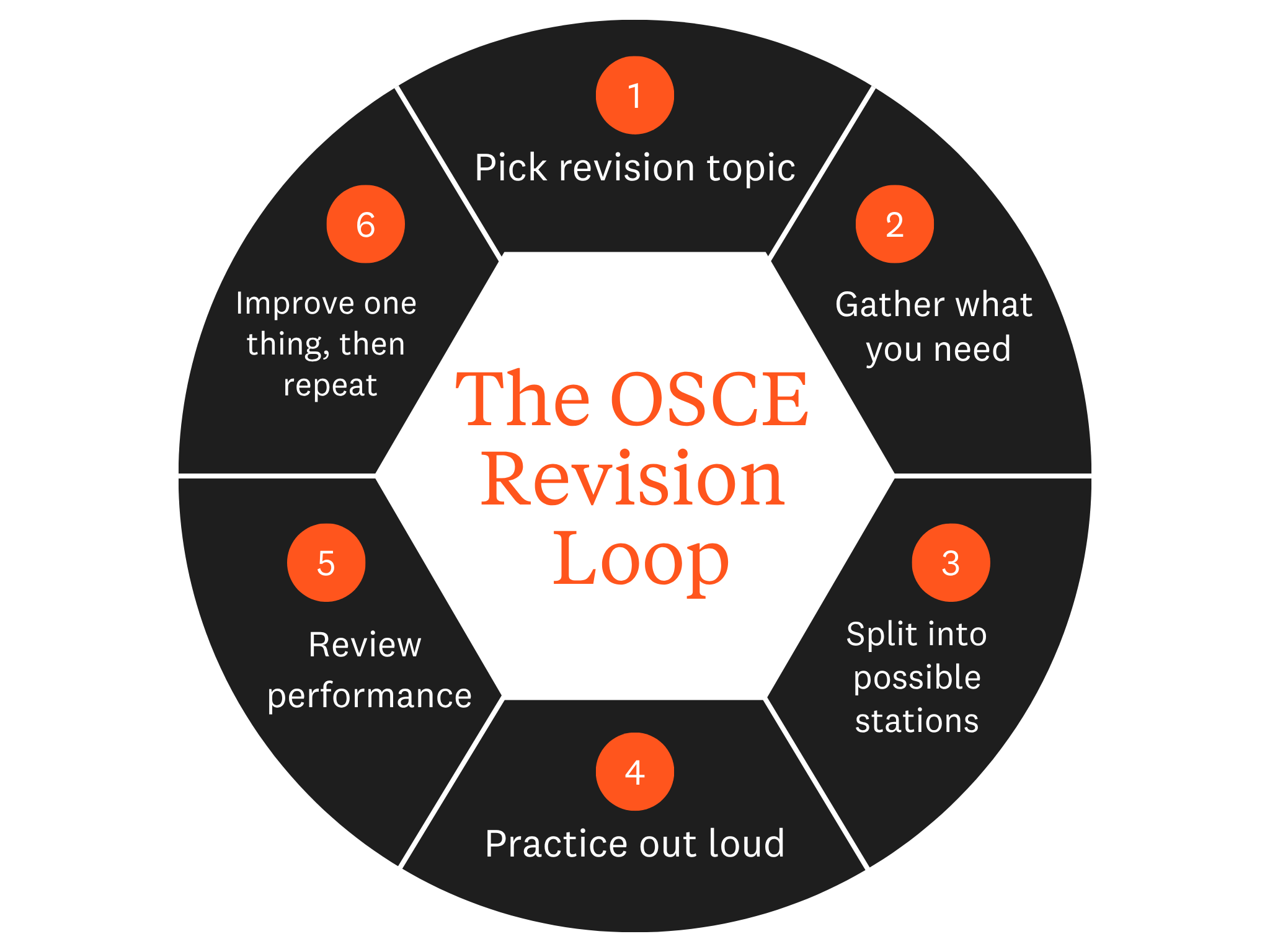
The common mistake is spending nearly all your time on the first two steps. If you want your performance to improve, you need to complete the full cycle.
Final thoughts
OSCEs aren’t about becoming a perfect actor or memorising a flawless script. They are about being safe, structured and understandable.
The students who improve fastest are usually not the ones who collect the most resources. They’re the ones who practise efficiently, notice what went wrong, and fix it.
So pick one topic, turn it into stations, practise it out loud, get feedback, and keep repeating the weak bits.
Good luck!
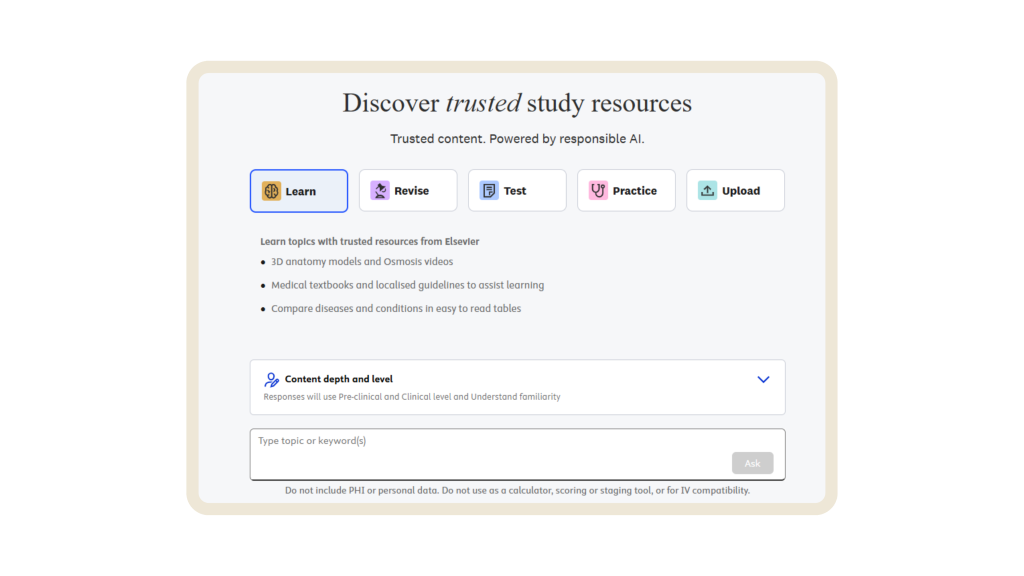
Content developed using ClinicalKey Student, StudyFinder AI, the new AI enhancement designed to help you find what you need faster!
Click here to check if you have StudyFinder AI access via your institution
Leave a Reply