
A Name That Carries On
When my name is no longer more than a memory, I hope my voice will carry on the work of my life.
-Florence Nightingale
Florence Nightingale’s greatest achievement was turning nursing into a respected science and, in 1860, founding the first professional nursing school. The Nightingale Training School at St Thomas’ Hospital, shows the impact of this woman.
Born on May 12, 1820, in the Italian city of Florence (hence her name), she spent the early years of her life traveling across Europe.
She received a classical, well-rounded education, but at 17, when she experienced what she called “the call,” she became convinced she was meant to devote her life to public service and caring for the less fortunate.
It would take a few more years for her to commit to nursing, despite family opposition and many obstacles: society expected women to “marry well,” and nursing lacked recognition.
After traveling across Europe and engaging with various health institutions, her big break came in October 1853 when the Crimean War erupted, pitting the Ottoman Empire, France, and Britain against Russia.
In the midst of the conflict, a sharply critical article in The Times denouncing Britain’s appalling medical facilities sparked a major scandal. To put an end to it, Sir Sidney Herbert, Secretary of War and Florence’s friend, conceived the idea of sending the young woman to the conflict zone so that she, with 38 other nurses, could take charge of Scutari Hospital—a town near Istanbul (Turkey)—to restore order and reorganize care.
On her return to London, her reputation preceded her. She used the opportunity to implement all the ideas that would define her view of the nursing profession.
Her doctrine, approaches to nursing practice, and the enduring validity of her legacy undoubtedly justify calling Florence Nightingale “the founder of nursing.”
Six Key Facts About Florence Nightingale
- Her name comes from the Italian city of Florence, where she was born on May 12, 1820.
- In Scutari, Nightingale proved herself not only as a great nurse but also as an innovative professional and an excellent manager.
- Just two weeks after Florence and her team of nurses arrived in Scutari, they managed to set up a kitchen that fed 800 men and a laundry where patients’ clothes were disinfected.
- By taking on the Scutari mission, Florence Nightingale became the first woman in history to be named an officer in the British Army.
- Since returning from Scutari, Florence has been ill: she suffered from a condition that would accompany her to her death for more than thirty years.
- For a time, this debility was attributed to her work in the Crimea, but today we know it was chronic brucellosis.
The Lady with the Lamp
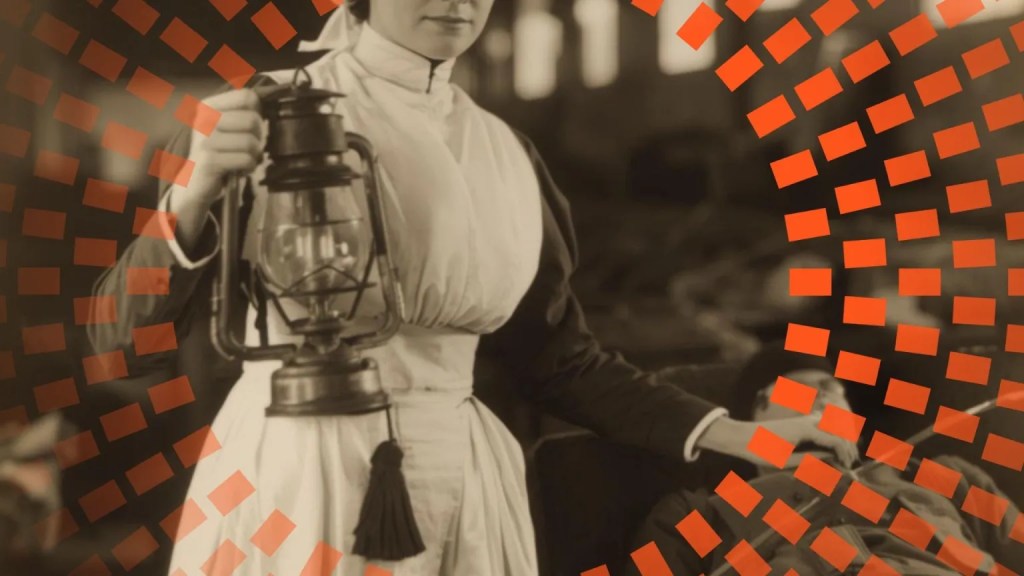
At Scutari, Nightingale emphasized the importance of constantly watching over patients, visiting the wards each night by lamp-light so as not to disturb their rest. This image became Florence’s most famous, and she would soon be nicknamed “the Lady with the Lamp.” The lamp she used to visit the sick has thus become a worldwide symbol of nursing.
Henry Wadsworth Longfellow, the American poet who had the chance to meet Florence during the Crimean War, captured this idea perfectly:
The wounded on battlefields in the gloomy halls of pain; the dreary corridors, the cold stone floors. Behold! In this house of misery I see a lady with a lamp. She moves through the flickering darkness, gliding from room to room. And slowly, as in a dream of happiness, the waiting world embraces her shadow once more as it falls on the dark walls.
This article was edited with the help of AI.
Leave a Reply