
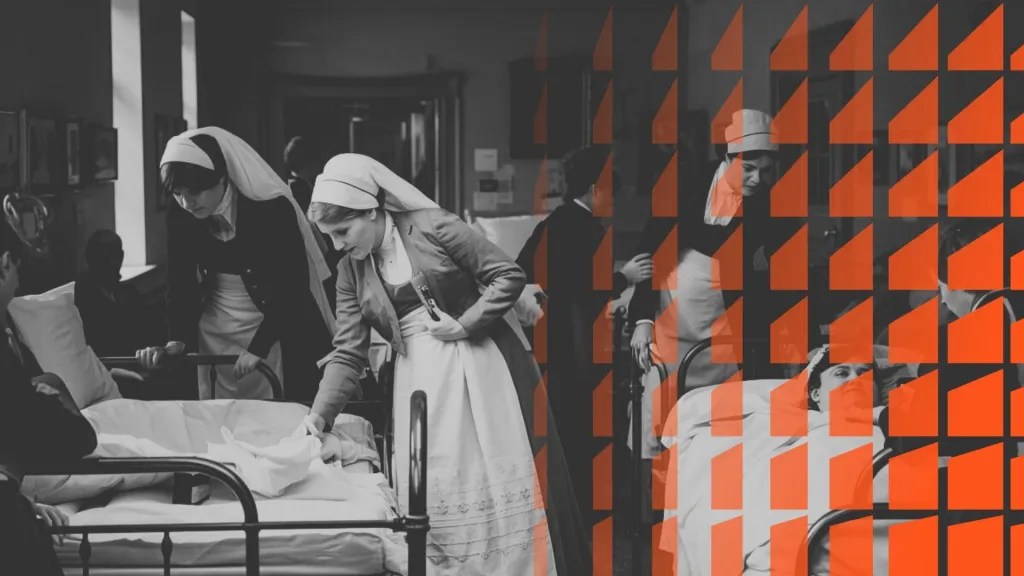
In England, the reign of Queen Victoria (1837-1901) coincided with a period of profound upheaval. The vast expansion of the British Empire was powered by the steam engine and remarkable technological advances. However, this rapid industrialization drove swift urbanization: British cities began to suffer from overcrowding, leading to the deterioration of sanitary conditions and growing poverty among the least affluent classes. Diseases such as cholera and typhoid spread readily.
Florence Nightingale was quick to perceive social changes and their impact on the health of the English population. The effects of the Industrial Revolution, with the emergence of new social classes, their specific diseases and social problems, highlighted notably in Dickens’s novels, contributed to the need for sanitary and social reform across the country. There is no doubt that the strategic alliance between Nightingale and Dickens exerted a decisive influence on the definition of healthcare as well as on the theorization of nursing care. Similar links with other intellectuals and social reformers of her time, such as John Stuart Mill, enriched Florence Nightingale’s philosophical and logical thinking, which is reflected in her theory of nursing care and in her tireless fight for social reforms,” explains Maria del Carmen Amaro Caro, nurse educator, in her article “Florence Nightingale, the first great theorist of nursing care.”
Beyond establishing rigorous protocols and her remarkable managerial skills, Florence Nightingale’s greatest achievement undoubtedly lies in her ability to anticipate many of the challenges facing health systems today, more than two centuries after her birth.
Did you know?
- Florence Nightingale and Charles Dickens maintained a cordial relationship and collaborated on a committee aimed at improving nurses’ working conditions.
- When Florence told her parents of her intention to become a nurse, they strongly discouraged her, arguing that a young woman of her social standing could not pursue a profession deemed at the time “degrading.”
- In the absence of formal professional training, care was mainly provided by nuns. There were, however, “unofficial” nurses, poorly trained and often poorly regarded, as they were accused of leading a “dissolute” life and lacking true vocation.
- To end this “dark period” of nursing, a student residence was established at the Nightingale School to instill discipline, rigor, and high standards.
Her Approach to Nursing
One of the cornerstones of Florence Nightingale’s thinking and work was to advocate for formal training for nurses, at a time when there were neither university degrees nor dedicated study programs for the profession.
Her Key Principles:
- Every day, nursing knowledge— the art of staying healthy, preventing illness, or recovering from it —becomes more important. It is knowledge distinct from medical knowledge, specific to a profession.
- Universal experience demonstrates the importance of nursing care in the progression of diseases. Yet one objection keeps coming back: ‘how can I acquire this medical knowledge? I am not a doctor. I must leave this task to them.’
Two centuries later…
According to Antonio Arribas, director of the Nursing Methodology Department at the Foundation for the Development of Nurses (FUDEN), the recognition of nursing as an autonomous practice, distinct from medicine, can be approached from several angles:
“If we focus on the purely academic aspect, this objective has been fully realized through recognizing nursing as an academic discipline, integrated into the health sciences domain with a clearly defined scope centered on care. Professionally, many advances have been made, but the path is not yet fully mapped. The foundations of the nursing profession and nursing knowledge continue to evolve.”
Antonio Arribas
Leave a Reply